
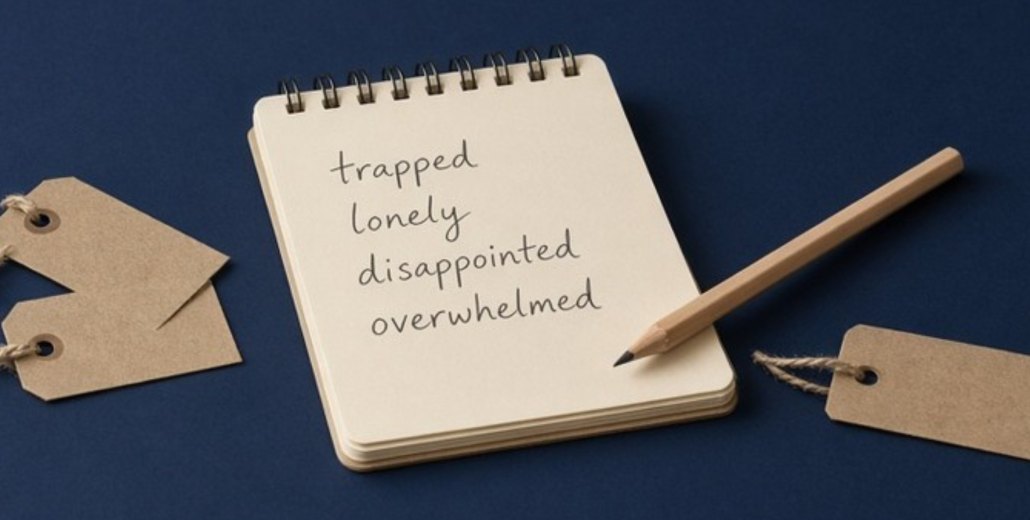
Name Your Feelings: The Quieter Words Under Angry and Sad
A few years ago I was standing in line at the post office behind a young mom and her little boy. He was maybe three. He kept wandering off toward the long hallway with the P.O. boxes, and she kept calling him back.
“Stand right here next to me. Don’t move.”
Finally he stopped, wrinkled up his nose, looked straight at her, and said through his little baby teeth, “I’m so angry.”
She didn’t tell him to calm down. She didn’t tell him he had no reason to be mad.
She just said, “That’s okay. Sometimes we get angry.”
I thought that was pretty great. That mom gave her son a word for what was happening inside him, and then she let him have the feeling.
Most of us can name the big, loud emotions.
- Angry
- Sad
- Happy
- Stressed
Those are easy to spot because they’re easy to feel.
But underneath the loud ones, there are dozens of quieter, more specific feelings.
- Disappointed
- Trapped
- Bitter
- Lonely
- Confused
- Embarrassed
- Resentful
- Unappreciated
You feel those too. You just may not have the words ready when they show up.
So instead of “I feel trapped,” what comes out is “I’m fine,” or “I’m just tired,” or a general sense that something is off and you can’t put your finger on it.
That vague knot is exhausting. It sits in your stomach or your chest and keeps your mind spinning and ruminating, because your brain is trying to solve a problem it hasn’t put a name on yet.
In my work with clients, building an emotional vocabulary is usually one of the first things we do. Before we can do any other good work together, you need to know what you’re actually feeling.
What the research says about putting feelings into words
This isn’t just a nice idea from therapy offices. Researchers have a name for it: affect labeling, which simply means: putting a feeling into words.
In one well-known brain imaging study, people looked at photos of faces showing strong emotions. When they picked a word to describe the emotion, activity in the amygdala, the brain’s alarm system, went down compared to other ways of looking at the same pictures.
At the same time, a part of the prefrontal cortex that helps with regulation became more active (Lieberman et al., 2007).
In other words, naming the feeling turned the alarm down a notch.
I first learned this in my corporate days. I remember feeling pretty amped up on my long commutes to and from work.
After hitting the third traffic jam in 20 minutes, I said out loud (and with some conviction), “I’m so frustrated right now!”
I let out a big exhale, and kept on driving.
Labeling my frustration didn’t make me smile, and it didn’t change the traffic.
But it took the heat off so I could focus on driving and get myself home.
Here comes the spider, man
Another study brought this into a real-life fear.
People who were afraid of spiders got close to a live spider several times. (Who signs up for this stuff?).
One group was asked to describe their feelings out loud as they went.
A week later, when they faced a different spider in a different room, the labeling group showed less physical fear response than the groups who tried to think about the spider differently or distract themselves (Kircanski et al., 2012).
Here’s the part I love most. The labeling group didn’t report feeling any less afraid. But their bodies calmed down anyway.
Researchers who reviewed this work describe affect labeling as a kind of quiet emotion regulation. It often doesn’t feel like you’re doing anything to manage the feeling, but it works in a similar direction (Torre & Lieberman, 2018).
That matters if you tend to wait until you feel better before you do anything.
If you follow or subscribe to me, you know how I feel about waiting to feel something before you do something.
You don’t have to feel calm first. You can name the emotion while it’s still messy, and that naming is already doing something for you.
Find your quiet word
“Angry” is a good start. But there’s a big difference between angry because you feel trapped, and angry because you feel unappreciated. Those two feelings need different things.
This skill is called emotion differentiation, or emotional granularity. It’s the ability to tell the difference between feelings that sit close together.
A review of this research found that people who describe their feelings in more specific ways tend to cope better under stress. When things get hard, they’re less likely to turn to things like drinking too much or lashing out, and they tend to have less severe anxiety and depression (Kashdan et al., 2015).
We have to be careful with this, because most of that research shows a link, not proof that one causes the other.
But the authors also point to evidence that this is a skill you can build. Nobody is born with a big emotional vocabulary.
That little boy at the post office is learning his one word at a time, and so can you, at any age.
Naming a feeling helps you say what you need
One of the most frustrating feelings in the world is feeling some kinda way and not being able to explain it to anyone.
When you have the word, the person in front of you can finally understand you. “I’m upset” leaves them guessing. “I’m feeling left out” gives them something to work with. They can say, “That makes sense,” and know how to help.
Or they can do what that mom did. They can just let you have the feeling without trying to fix it or talk you out of it.
Naming a feeling helps you sit with it
A lot of us were raised to push hard feelings away.
- Don’t cry
- Don’t make a fuss
- Be grateful.
So when a big feeling rises up, the reflex is to avoid it, stay busy, or turn it into a to-do list.
Naming it is the opposite of avoiding it. When you can say, “This is disappointment,” you’re letting it be there instead of fighting it. And it usually gets a little easier to carry. You can sit with it for a minute, notice it’s not the end of the world, and move on to something else.
It also reminds you that you’re not the only one. Disappointment has a name because millions of people have felt it. Congratulations, human. You’re having a very human experience.
Start with your body
If you’ve gone years without naming your feelings, you may not know where to begin. That’s okay. Start with your body, because it usually knows before your mind does.
A feeling often shows up first as a sensation.
- Tightness in your chest
- A heaviness in your body
- Heat maybe running up your neck
- A fluttery stomach that won’t go away
- Shoulders creeping up toward your ears
Once you notice where it lives in your body, it’s easier to ask what it might be.
Your best first move
Here’s something to practice this week. You don’t have to be good at it, and you don’t have to feel ready.
1. Notice the sensation first.
When something rises up, pause and find it in your body. Where is it? What does it feel like? Tight, heavy, hot, buzzy?
2. Start with the broad word.
Ask yourself, “If this sensation had a name, what would it be?” Begin with the word you already know. Angry. Sad. Stressed. Tired. Anything is better than “bad” or “off.”
3. Go one word deeper.
Is it closer to disappointed? Trapped? Lonely? Bitter? Confused? Try a couple on and see which one fits the sensation best. There’s no wrong answer.
4. Write it down.
Keep a little list on your phone or a sticky note. By the weekend you may have your own vocabulary list for emotions (like any good language student), and you might be surprised how many different feelings you’re actually having.
You don’t have to fix any of them. Just name it, notice it, and let it be. Then go do the next thing in your day.
You don’t have to understand a feeling all the way to name it. The name is where understanding starts.
What word do you think will show up for you this week?
I talk through the post office story in my short video, You can name angry, but can you name trapped? Watch it above, and for more like it, subscribe to my YouTube channel @LoriMiller.
References
Kashdan, T. B., Barrett, L. F., & McKnight, P. E. (2015). Unpacking emotion differentiation: Transforming unpleasant experience by perceiving distinctions in negativity. Current Directions in Psychological Science, 24(1), 10–16. https://doi.org/10.1177/0963721414550708
Kircanski, K., Lieberman, M. D., & Craske, M. G. (2012). Feelings into words: Contributions of language to exposure therapy. Psychological Science, 23(10), 1086–1091. https://doi.org/10.1177/0956797612443830
Lieberman, M. D., Eisenberger, N. I., Crockett, M. J., Tom, S. M., Pfeifer, J. H., & Way, B. M. (2007). Putting feelings into words: Affect labeling disrupts amygdala activity in response to affective stimuli. Psychological Science, 18(5), 421–428. https://doi.org/10.1111/j.1467-9280.2007.01916.x
Torre, J. B., & Lieberman, M. D. (2018). Putting feelings into words: Affect labeling as implicit emotion regulation. Emotion Review, 10(2), 116–124. https://doi.org/10.1177/1754073917742706

Leave a Reply
Want to join the discussion?Feel free to contribute!